



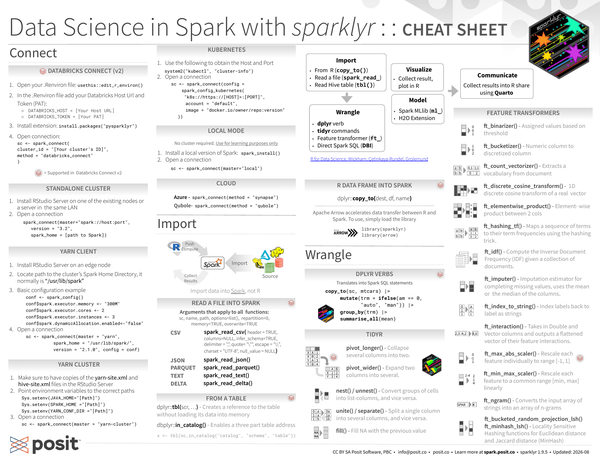
Connect#
Databricks Connect (v2)#
Supported in Databricks Connect v2
-
Open your .Renviron file:
usethis::edit_r_environ() -
In the .Renviron file add your Databricks Host Url and Token (PAT):
DATABRICKS_HOST = \[Your Host URL\]DATABRICKS_TOKEN = \[Your PAT\]
-
Install extension:
install.packages("pysparklyr") -
Open connection:
sc <- spark_connect(
  cluster_id = "[Your cluster’s ID]",
  method = "databricks_connect"
)
Standalone cluster#
-
Install RStudio Server on one of the existing nodes or a server in the same LAN
-
Open a connection
spark_connect(
  master = "spark://host:port",
  version = "3.2",
  spark_home = "[path to Spark]"
)
Yarn client#
-
Install RStudio Server on an edge node
-
Locate path to the clusterʼs Spark Home Directory, it normally is
"/usr/lib/spark" -
Basic configuration example
conf <- spark_config()
conf$spark.executor.memory <- "300M"
conf$spark.executor.cores <- 2
conf$spark.executor.instances <- 3
conf$spark.dynamicAllocation.enabled <- "false"- Open a connection
sc <- spark_connect(
  master = "yarn",
  spark_home = "/usr/lib/spark/",
  version = "2.1.0",
  config = conf
)
Yarn cluster#
-
Make sure to have copies of the yarn-site.xml and hive-site.xml files in the RStudio Server
-
Point environment variables to the correct paths
Sys.setenv(JAVA_HOME = "[Path]")
Sys.setenv(SPARK_HOME = "[Path]")
Sys.setenv(YARN_CONF_DIR = "[Path]")- Open a connection
sc <- spark_connect(master = "yarn-cluster")Kubernetes#
-
Use the following to obtain the Host and Port
system2("kubectl", "cluster-info") -
Open a connection
sc <- spark_connect(
  config = spark_config_kubernetes(
    "k8s://https://[HOST]>:[PORT]",
    account = "default",
    image = "docker.io/owner/repo:version"
  )
)
Local mode#
No cluster required. Use for learning purposes only
-
Install a local version of Spark: spark_install()
-
Open a connection
sc <- spark_connect(master = "local")Cloud#
Azure - spark_connect(method = "synapse")
Qubole - spark_connect(method = "qubole")

Import#

Import data into Spark, not R
Read a file into Spark#
Arguments that apply to all functions:
sc, name, path, options=list(), repartition=0, memory=TRUE, overwrite=TRUE
- CSV:
spark_read_csv(header = TRUE, columns = NULL, infer_schema = TRUE, delimiter = ",", quote= "\"", escape = "\\", charset = "UTF-8", null_value = NULL) - JSON:
spark_read_json() - PARQUET:
spark_read_parquet() - TEXT:
spark_read_text() - DELTA:
spark_read_delta()
From a table#
-
dplyr::tbl(scr, ...)- Creates a reference to the table without loading its data into memory -
dbplyr::in_catalog()- Enables a three part table address
x <- tbl(sc, in_catalog("catalog", "schema", "table"))R data frame into Spark#
Supported in Databricks Connect v2
dplyr::copy_to(dest, df, name)Apache Arrow accelerates data transfer between R and Spark. To use, simply load the library
library(sparklyr)
library(arrow)Wrangle#
dplyr verbs#
Supported in Databricks Connect v2
Translates into Spark SQL statements
copy_to(sc, mtcars) |>
  mutate(trm = ifelse(am == 0, "auto", "man")) |>
  group_by(trm) |>
summarise_all(mean)tidyr#
-
pivot_longer()- Collapse several columns into two. (Supported in Databricks Connect v2) -
pivot_wider()- Expand two columns into several. (Supported in Databricks Connect v2) -
nest()/unnest()- Convert groups of cells into list-columns, and vice versa. -
unite()/separate()- Split a single column into several columns, and vice versa. -
fill()- Fill NA with the previous value.
Feature transformers#
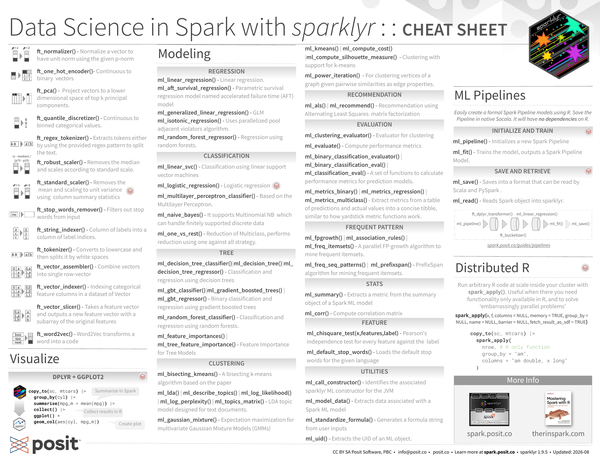
ft_binarizer()- Assigned values based on thresholdft_bucketizer()- Numeric column to discretized columnft_count_vectorizer()- Extracts a vocabulary from documentft_discrete_cosine_transform()- 1D discrete cosine transform of a real vectorft_elementwise_product()- Element- wise product between 2 colsft_hashing_tf()- Maps a sequence of terms to their term frequencies using the hashing trick.ft_idf()- Compute the Inverse Document Frequency (IDF) given a collection of documents.ft_imputer()- Imputation estimator for completing missing values, uses the mean or the median of the columns.ft_index_to_string()- Index labels back to label as stringsft_interaction()- Takes in Double and Vector columns and outputs a flattened vector of their feature interactions.ft_max_abs_scaler()- Rescale each feature individually to range [-1, 1] (Supported in Databricks Connect v2)ft_min_max_scaler()- Rescale each feature to a common range [min, max] linearlyft_ngram()- Converts the input array of strings into an array of n-gramsft_bucketed_random_projection_lsh()ft_minhash_lsh()- Locality Sensitive Hashing functions for Euclidean distance and Jaccard distance (MinHash)ft_normalizer()- Normalize a vector to have unit norm using the given p-normft_one_hot_encoder()- Continuous to binary vectorsft_pca()- Project vectors to a lower dimensional space of top k principal componentsft_quantile_discretizer()- Continuous to binned categorical values.ft_regex_tokenizer()- Extracts tokens either by using the provided regex pattern to split the textft_robust_scaler()- Removes the median and scales according to standard scaleft_standard_scaler()- Removes the mean and scaling to unit variance using column summary statistics (Supported in Databricks Connect v2)ft_stop_words_remover()- Filters out stop words from inputft_string_indexer()- Column of labels into a column of label indices.ft_tokenizer()- Converts to lowercase and then splits it by white spacesft_vector_assembler()- Combine vectors into single row-vectorft_vector_indexer()- Indexing categorical feature columns in a dataset of Vectorft_vector_slicer()- Takes a feature vector and outputs a new feature vector with a subarray of the original featuresft_word2vec()- Word2Vec transforms a word into a code
Visualize#
dplyr + ggplot2#
Supported in Databricks Connect v2
copy_to(sc, mtcars) |>
  group_by(cyl) |>
  summarise(mpg_m = mean(mpg)) |> # Summarize in Spark
  collect() |> # Collect results in R
  ggplot() +
geom_col(aes(cyl, mpg_m)) # Create plotModeling#
Regression#
ml_linear_regression()- Linear regression.ml_aft_survival_regression()- Parametric survival regression model named accelerated failure time (AFT) model.ml_generalized_linear_regression()- GLM.ml_isotonic_regression()- Uses parallelized pool adjacent violators algorithm.ml_random_forest_regressor()- Regression using random forests.
Classification#
ml_linear_svc()- Classification using linear support vector machines.ml_logistic_regression()- Logistic regression. (Supported in Databricks Connect v2)ml_multilayer_perceptron_classifier()- Based on the Multilayer Perceptron.ml_naive_bayes()- It supports Multinomial NB which can handle finitely supported discrete data.ml_one_vs_rest()- Reduction of Multiclass, performs reduction using one against all strategy.
Tree#
ml_decision_tree_classifier(),ml_decision_tree(), `ml_decision_tree_regressor(). - Classification and regression using decision trees.ml_gbt_classifier(),ml_gradient_boosted_trees(),ml_gbt_regressor()- Binary classification and regression using gradient boosted trees.ml_random_forest_classifier()- Classification and regression using random forests.ml_feature_importances(),ml_tree_feature_importance()- Feature Importance for Tree Models.
Clustering#
ml_bisecting_kmeans()- A bisecting k-means algorithm based on the paper.ml_lda(),ml_describe_topics(),ml_log_likelihood(),ml_log_perplexity(),ml_topics_matrix()- LDA topic model designed for text documents.ml_gaussian_mixture()- Expectation maximization for multivariate Gaussian Mixture Models (GMMs).ml_kmeans(),ml_compute_cost(),ml_compute_silhouette_measure()- Clustering with support for k-means.ml_power_iteration()- For clustering vertices of a graph given pairwise similarities as edge properties.
Recommendation#
ml_als(),ml_recommend()- Recommendation using Alternating Least Squares matrix factorization.
Evaluation#
ml_clustering_evaluator()- Evaluator for clustering.ml_evaluate()- Compute performance metrics.ml_binary_classification_evaluator(),ml_binary_classification_eval(),ml_classification_eval()- A set of functions to calculate performance metrics for prediction models.ml_metrics_binary(),ml_metrics_regression(),ml_metrics_multiclass()- Extract metrics from a table of predictions and actual values into a concise tibble, similar to how yardstick metric functions work.
Frequent pattern#
ml_fpgrowth(),ml_association_rules(),ml_freq_itemsets()- A parallel FP-growth algorithm to mine frequent itemsets.ml_freq_seq_patterns(),ml_prefixspan()- PrefixSpan algorithm for mining frequent itemsets.
Stats#
ml_summary()- Extracts a metric from the summary object of a Spark ML model.ml_corr()- Compute correlation matrix.
Feature#
ml_chisquare_test(x,features,label)- Pearson’s independence test for every feature against the label.ml_default_stop_words()- Loads the default stop words for the given language.
Utilities#
ml_call_constructor()- Identifies the associated sparklyr ML constructor for the JVM.ml_model_data()- Extracts data associated with a Spark ML model.ml_standardize_formula()- Generates a formula string from user inputs.ml_uid()- Extracts the UID of an ML object.
ML pipelines#
Easily create a formal Spark Pipeline models using R. Save the Pipeline in native Sacala. It will have no dependencies on R.
Initialize and train#
Supported in Databricks Connect v2
ml_pipeline()- Initializes a new Spark Pipeline.ml_fit()- Trains the model, outputs a Spark Pipeline Model.
Save and retrieve#
Supported in Databricks Connect v2
ml_save()- Saves into a format that can be read by Scala and PySpark.ml_read()- Reads Spark object into sparklyr.

spark.posit.co/guides/pipelines
Distributed R#
Supported in Databricks Connect v2
Run arbitrary R code at scale inside your cluster with spark_apply(). Useful when there you need functionality only available in R, and to solve ’embarrassingly parallel problems'.
spark_apply(
  x,
  f,
  columns = NULL,
  memory = TRUE,
  group_by = NULL,
  name = NULL,
  barrier = NULL,
  fetch_result_as_sdf = TRUE
)copy_to(sc, mtcars) |>
spark_apply(
nrow, # R only function
group_by = "am",
columns = "am double, x long"
)CC BY SA Posit Software, PBC • info@posit.co • posit.co
Learn more at spark.posit.co and therinspark.com.
Updated: 2026-10.
packageVersion("sparklyr")[1] '1.9.5'

