


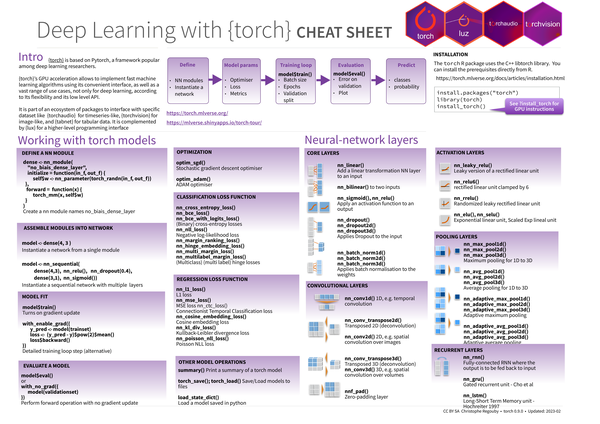
The torch R package is based on PyTorch and provides a flexible low-level interface for building neural networks with optional GPU acceleration. It supports defining custom modules, assembling sequential networks, training loops, and a broad set of layer types for image, text, and tabular data.
What’s covered#
- Working with torch models –
nn_module,nn_sequential, model fit and evaluation - Optimization –
optim_sgd,optim_adam - Classification loss functions –
nn_cross_entropy_loss,nn_bce_loss,nn_nll_loss, and others - Regression loss functions –
nn_l1_loss,nn_mse_loss,nn_kl_div_loss, and others - Neural-network layers –
nn_linear,nn_sigmoid,nn_relu,nn_dropout,nn_batch_norm1d - Convolutional layers –
nn_conv1d,nn_conv2d,nn_conv3d, transposed convolutions - Pooling layers – max pooling, average pooling, and adaptive pooling (1D–3D)
- Recurrent layers –
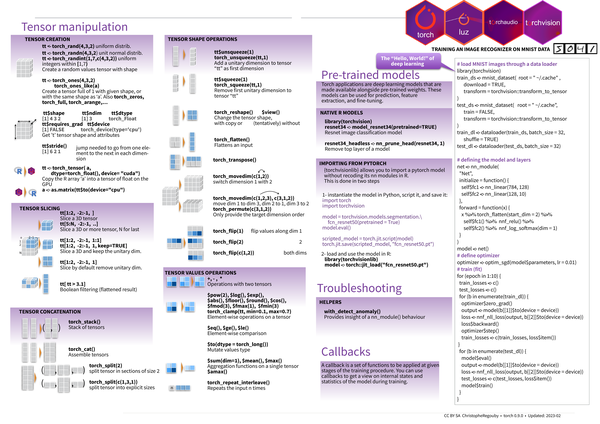
nn_rnn,nn_gru,nn_lstm - Tensor manipulation – creation, shape operations, slicing, concatenation, and value operations
- Pre-trained models and importing from PyTorch


